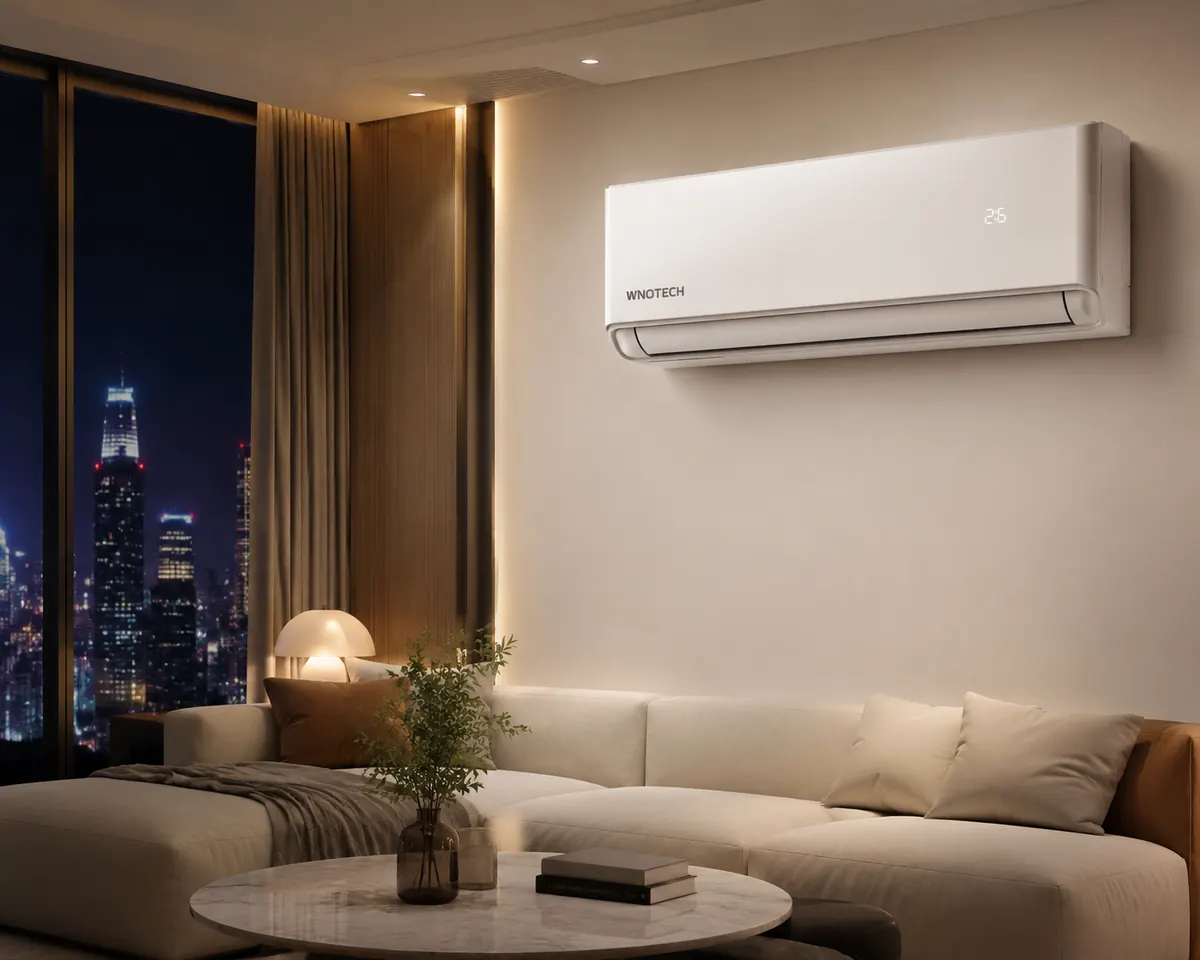
Rwanda holds two cooling markets in one small, high-altitude country. On the central plateau, air conditioning is a comfort product for hotels, offices, clinics and apartment towers; in the warm south-western valleys and eastern savanna, it runs most of the year. Four things decide whether a first container works: regulation, specification, corridor and model mix.
One country, two climates
Rwanda’s meteorological service divides the country by annual temperature: warmest averages in the eastern lowlands (20–21°C) and the Bugarama Valley (23–24°C), the central plateau at 17.5–19°C, the highlands below 17°C. Kigali sits at 1,567 m — which is why the capital feels mild while a valley three hours away feels tropical.
| Zone | Typical annual pattern | What to specify |
|---|---|---|
| Kigali, central plateau | 17.5–19°C average, cool nights, 1,500–1,800 m | 9K–12K inverter; heat pump for shoulder-season heating |
| Eastern lowlands (Nyagatare, Kayonza) | Warmest averages, dry savanna, dust | T3-rated outdoor unit, dust-tolerant filters, capacity one size up |
| Bugarama Valley, Rusizi, Lake Kivu shore | 23–24°C average, persistent humidity | T3 mandatory, coil coating, drainage sized for constant humidity |
| Northern highlands (Musanze, Kinigi) | Below 17°C average | Heat pump plus low-ambient heating kit |
The plateau buys comfort, the lowlands buy necessity: a container weighted to the capital alone leaves money on the table inland. Thinner air at 1,567 m also means a nominal 12,000 BTU unit moves less air mass across the coils than at sea level, so ask for capacity data at the installation altitude and confirm the sizing table with sales.
The regulatory window: get performance data with the quotation
Rwanda adds a standards layer importers usually hear about after the container has sailed. The standards body is the Rwanda Standards Board (RSB): health, safety and environmental standards are mandatory for imports as well as local production, and products in those categories need authorisation from RSB — and from the Rwanda FDA where relevant — through the Rwanda Single Electronic Window. RSB and FDA officers can also inspect at the importer’s premises, faster and cheaper than leaving a container at a border post.
A second layer is being finalised. RICA, the Rwanda Inspectorate, Competition and Consumer Protection Authority, is issuing a Technical Regulation for Electrical and Electronic Equipment with the Rwanda Environment Management Authority (REMA) and UNEP’s United for Efficiency initiative. A national validation workshop in Kigali in March 2025 closed the drafting phase and moved the text toward publication.
That regulation sets Minimum Energy Performance Standards (MEPS) and mandatory energy labelling for domestic refrigerators, air conditioners up to 16 kW and lighting, aligned with recently approved East African Community standards, and adds product safety and extended producer responsibility.
An energy label is built from test-based performance data, not from a datasheet written on arrival: if a MEPS threshold applies to your models, capacity, power input and efficiency figures must exist when the label is requested — and they come from the factory.
- Ask for performance data at quotation stage: capacity at rated and at actual conditions, power input and efficiency ratio, for the exact model and voltage version you buy.
- Confirm the regulation’s status before booking production. Ask RICA or RSB which standard applies to your models and when; treat any summary, including this one, as a starting point, not a legal opinion.
Rwanda’s cooling policy also sits inside the Kigali Amendment HFC phase-down, pointing the market toward lower-GWP refrigerants: R32 is the safer long-term platform — confirm the version on your order.
Getting the container to Kigali
Rwanda has no seaport. Cargo reaches Kigali on the Northern Corridor via Mombasa and Kampala, or the Central Corridor via Dar es Salaam and Isaka; the revenue authority keeps a presence at Mombasa so goods can be declared for Rwanda at the corridor origin. Which route is cheaper or faster shifts with congestion, fuel and season — ask a licensed clearing agent.
- Order by the full container. A 40HQ takes 292 sets of the 12K wall-mounted platform, and inland transit is priced per container: empty cubic metres are paid for twice. Consolidate to three or four capacities, not eight.
- Keep the document set consistent. Invoice, packing list, bill of lading, certificate of origin and the conformity authorisation requested through the Single Electronic Window must show the same model codes, capacities and refrigerant; mismatches are the top cause of clearance delay. Get duty and VAT rates in writing from your agent.
Power quality, not voltage
Rwanda runs on 230 V / 50 Hz with type C and J sockets — a direct match for the standard export platform, unlike 110 V/60 Hz markets where compressor and PCB changes are unavoidable. The variable is stability, not voltage.
- Wide voltage input. A unit rated at exactly 230 V has nothing left for the low end of a difficult day; one rated 198–242 V absorbs the range.
- Auto restart and low-inrush inverter. After an outage the unit returns to its last setting, and gentler starting current matters wherever it shares a generator.
- Three-phase where available. Quote 36K and above — floor-standing and cassette — in three-phase for hotels and commercial buildings.
One catalogue example: the WN-EL12K wall-mounted inverter from Hubei Wunuo Technology Co., Ltd is rated 198–242 V / 50–60 Hz with R32 and an outdoor range of -15°C to +48°C; the matching IP24 outdoor unit is offered with a T3 option to +52°C.
A working model mix for the first container
- 9,000 BTU — bedrooms, guest rooms, small offices
- 12,000 BTU — apartments, shops, hotel rooms; the workhorse
- 18,000 BTU — living areas, restaurants, small clinics
- 24,000 BTU — open offices and retail floors
- 36,000 BTU floor or cassette — hotel lobbies and conference rooms
Keep the platform identical across the range so one spare-parts set covers the container, and take the full OEM package on models you intend to repeat.
After-sales: the English-language advantage
English is an official language of Rwanda alongside Kinyarwanda and French, so English service manuals, installation guides and warranty terms go straight to the technician without translation — a real cost advantage over francophone and lusophone neighbours, and worth writing into the OEM agreement. Before paying a deposit, get in writing: the spare-parts list (PCB, capacitor, NTC sensor, fan motor, remote controls); English service manuals; warranty terms separating factory defects from installation faults; and training material for your first technical team.
Choosing the factory
Hubei Wunuo Technology Co., Ltd manufactures split air conditioners for distributor and OEM programmes, including wide-voltage inverter platforms and T3-capable outdoor units. The question is not which unit is cheapest, but whether the factory delivers the same specification on the third container as on the first — and whether it can supply the performance data a labelling scheme will require.
Confirm capacity, voltage version, refrigerant and packaging with the sales team: MOQ, lead time and price depend on model, quantity, branding and destination.
Planning a first container to Kigali? Contact us at info@hubei-uno.com or on WhatsApp at +86 159 2631 2664 for a specification-focused quotation.