Barbados is a small, mature, English-speaking island market with a grid that surprises first-time exporters: 115V at 50Hz. The voltage looks North American; the frequency does not. That single combination decides which version of a split system you can sell, and it is settled before production, not in the warehouse.
Two decisions carry a first container: the electrical version you order, and whether the equipment is specified for salt air and hurricane season.
115V at 50Hz: the combination that decides the order
Barbados runs a 115V / 50Hz supply with type A and B sockets, the North American plug pattern on a European frequency. Mains tables list the island at 115/200V, 50Hz, so larger commercial premises may be served at a higher voltage or by a three-phase supply. Confirm the service at the site with the electrician before you commit to a version.
- Voltage changes hardware. Compressor, electronic board and transformer follow the voltage version you order. A 220-240V model cannot be adapted to a 115V building on site; the version is a factory decision made at quotation.
- Frequency is the good news. Because the island is 50Hz, the frequency mismatch that penalises 60Hz markets does not apply here.
| Premises | Supply to confirm | What to specify |
|---|---|---|
| Guest rooms, apartments, small offices | 115V single phase, 50Hz | 9K to 12K inverter, quiet indoor unit |
| Villas, restaurants, small retail | 115V or 200V depending on the service | 18K to 24K, voltage version confirmed at quotation |
| Hotels and commercial interiors | 200-230V or three phase where available | 24K to 36K cassette or floor standing, wide-voltage inverter |
Tell the factory the supply you will actually meet, ask which voltage versions exist for the model and capacity you want, and put the answer in writing.
BNSI and the import conformity programme
Barbados has its own standards framework and its own customs administration. The Barbados National Standards Institution has been developing an import conformity assessment and pre-certification programme, and product certification follows a formal application procedure. Importers may also need to complete import qualification registration with the customs and tax administration in advance.
Do not assume that another CARICOM market’s scheme applies here. Before production, ask your importer, the national standards institution and a licensed customs broker for the current document list for your HS line, and confirm whether any conformity, registration or labelling document is required at import.
The principle behind the check is always the same: capacity, power input and efficiency are measured at the factory. If a certificate or a label depends on those figures, they must exist at quotation, not after the container lands.
Salt air, storms and a small grid
Between June and November the risk is not comfort but survival: an outdoor unit is a heavy box on a bracket.
- Mounting, not just installation. Galvanised or stainless brackets with wind-rated fasteners, and a check of the wall, not only of the unit.
- Coastal coil protection. Salt spray attacks aluminium and copper. Specify corrosion-resistant fin coating, a galvanised chassis and galvanised hardware. IP24 is a water and dust rating on the outdoor unit, not a corrosion treatment.
- Power after the storm. Grid restoration can lag and can come back in steps. Low-inrush inverter starting, auto restart and surge protection matter more here than in a mainland market. Where a commercial building is served at 220-240V, a platform declared across a wide input range, such as the WN-EL12K from Hubei Wunuo Technology Co., Ltd at 198-242V, rides through the dips that stop a narrowly rated unit.
Bridgetown, cargo and container planning
Bridgetown handles the island’s container trade through a deep-water port. Routing, sailing schedules and local handling are points to confirm with a licensed freight forwarder before production is booked.
- Buy by the full container. A 40HQ takes 292 sets of the 12K wall-mounted platform according to the WN-EL12K data sheet, so confirm the loading figure per model and packaging with sales. On an island, empty space is paid for twice.
- Keep the document set consistent. Invoice, packing list, bill of lading and certificate of origin must show identical model codes, capacities and refrigerant.
- Duties, levies and processing fees: ask a licensed customs broker for a written estimate. Published figures are not a quotation, and CARICOM tariff treatment depends on origin rules your broker will verify.
Hotel, villa and replacement demand
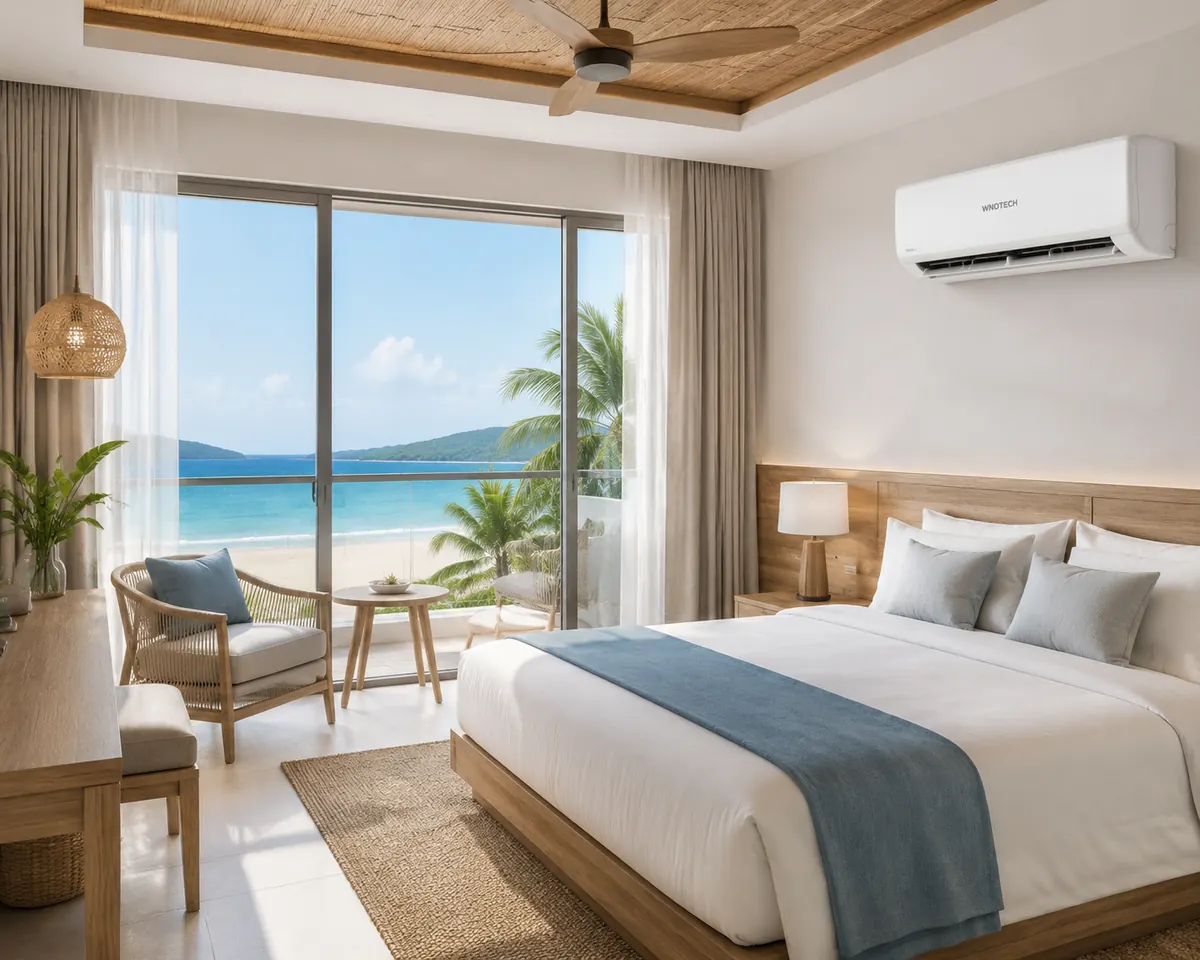
Tourism and a mature housing stock drive the specification more than price does. Hotel rooms, resorts and villa rentals buy comfort and reliability; a noisy unit in a guest room becomes a complaint, and a failed unit in high season becomes a refund.
- Guest rooms: 9K to 12K inverter, indoor sound pressure around 50 dB(A) or lower, easy filter access for housekeeping.
- Public areas: 24K to 36K cassette for lobbies and restaurants, where only the panel should be visible, or floor standing where ceiling space is unavailable.
Model mix for a first container
- 9K and 12K inverter: guest rooms, apartments, small offices.
- 18K: living rooms, small retail, medical rooms.
- 24K: open commercial areas; three-phase where the building supplies it.
- 36K cassette or floor standing: lobbies, conference rooms, restaurants.
- Critical spares: electronic board, capacitors, NTC sensors, fan motors, remote controls.
Keep one platform across the container: one spare parts set then covers every capacity, and the distributor’s technician learns a single diagnostic logic.
After-sales: English is free, distance is not
English is the working language, so manuals, warranty terms and training material reach the technician without translation. What costs money is inventory depth: an island distributor cannot borrow a board from a neighbouring branch, so the spare parts question is answered at the order stage or not at all.
Before paying the deposit, get in writing: the critical spare parts list, installation and service manuals, a warranty that separates factory defect from installation defect, and the factory’s remote support route, including Wi-Fi control options where the model supports them.
Choosing the manufacturer
Hubei Wunuo Technology Co., Ltd builds split systems for distributor and private-label programmes, including wide-voltage inverter platforms and outdoor units with a T3 option. One example from the catalogue: the WN-EL12K is declared at 198-242V / 50-60Hz, with R32 refrigerant and an outdoor operating range of -15 C to +48 C; the WN-OU outdoor unit is offered with a T3 option up to 52 C and service ports on both the high and low pressure sides. Declared certifications (CE, CB, ROHS, ISO 9001) are confirmed per model and per order.
The useful question is not which unit costs less, but whether the factory ships the same specification on the third container as on the first. Confirm capacity, voltage version, refrigerant and packaging with the sales team: MOQ, lead time and price depend on model, quantity, branding and destination.
Planning a first container to Bridgetown? Contact us at info@hubei-uno.com or on WhatsApp at +86 159 2631 2664 for a specification-focused quotation.
For the specification table and the quotation route in one place, see the Barbados split air conditioner supplier page; for private-label programmes see OEM/ODM air conditioners.