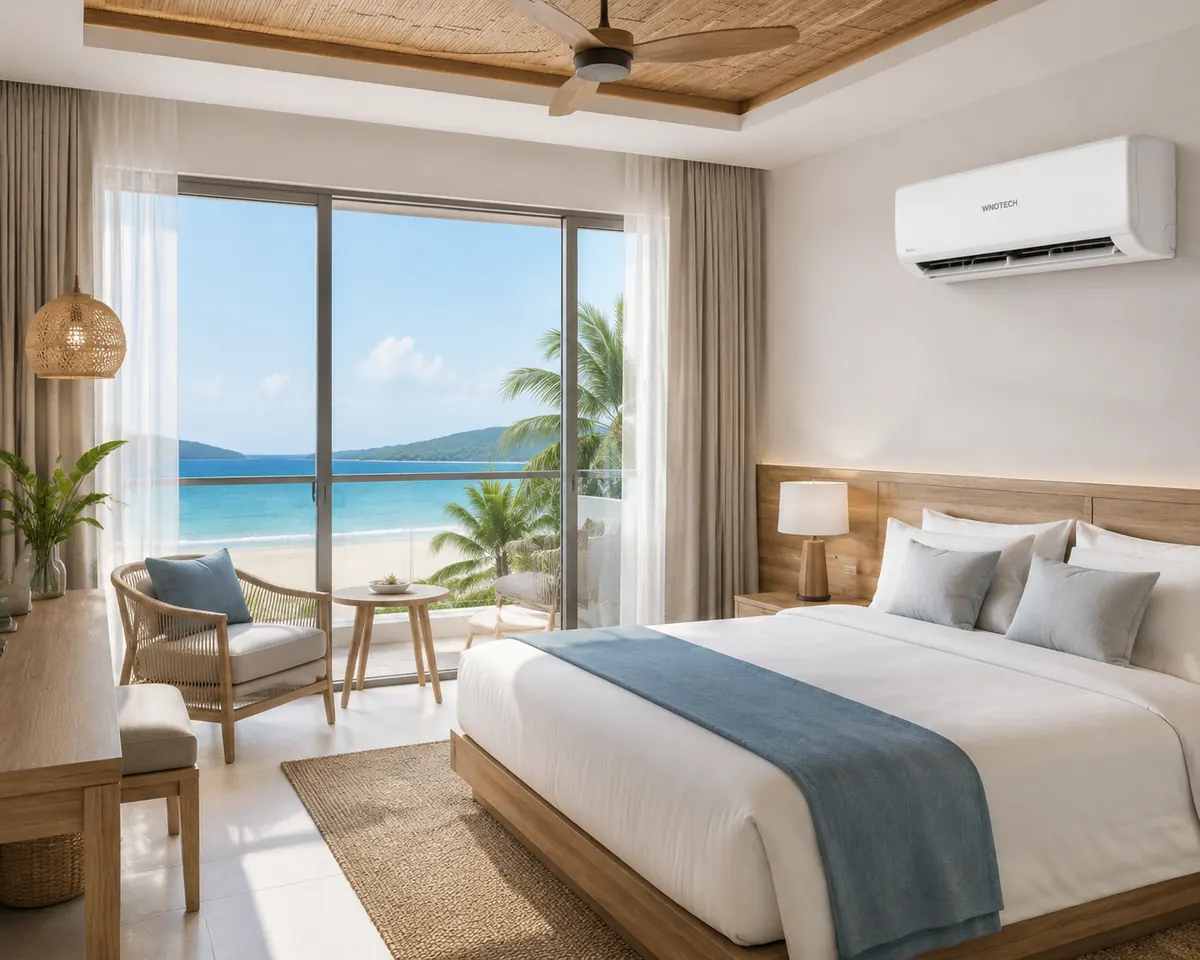
Tropical and high-ambient-temperature markets present unique technical challenges for air conditioner products. Standard residential split ACs designed for temperate climates often underperform or fail prematurely when deployed in environments where outdoor temperatures regularly exceed 40°C, humidity is persistently high, or coastal salt air accelerates corrosion.
This guide covers the key technical specifications importers should prioritize when sourcing air conditioners for tropical markets.
How to Choose an Air Conditioner for a Tropical Climate
Choosing an air conditioner for a tropical climate is a specification exercise, not a price exercise. Where outdoor temperatures regularly pass 40°C, humidity stays high year-round and coastal salt air attacks every metal surface, a unit built for a temperate climate will be back at your service desk within a season. Check these six points in order:
- Ambient temperature rating (T1 vs T3). Standard units are rated at 43°C. Where summer peaks exceed that, specify T3-rated or tropical-spec outdoor units.
- Coil and chassis corrosion protection. Gold-fin or coated coils and a chassis that protects the electrics from salt and spray. This is the single biggest driver of warranty claims in coastal markets.
- Humidity and dehumidification performance. Tropical buyers judge a unit by how it handles a damp room, not by cooling speed alone.
- Voltage stability. Weak or fluctuating grids require a wide voltage range and surge protection.
- Spare parts availability. Compressor, PCB and capacitor supply must be predictable — a repair waiting for a part damages your brand more than the original fault.
- Local compliance. Certification requirements differ by market (SASO, ESMA, BEE, CE/CB and others). Confirm them before production, not after.
If a supplier cannot answer each of these points in writing, they are not a tropical-market supplier.
Understanding Ambient Temperature Ratings
The single most important specification for tropical market products is the maximum ambient operating temperature of the outdoor unit.
Standard air conditioners are tested and rated at a maximum ambient temperature of 43°C (T1 climate class per ISO 5151). In many tropical markets — particularly the Arabian Peninsula, South Asia, and parts of Africa — outdoor temperatures regularly exceed this threshold during peak summer months.
T3 climate class products are rated for ambient temperatures up to 52°C and are specifically designed for these extreme conditions. Key design differences include:
- Larger condenser coil surface area for improved heat rejection
- Higher-capacity condenser fan motor
- Tropical-grade compressor oil with enhanced viscosity stability
- Reinforced capacitor and control board rated for high-temperature operation
WNOTECH AIR’s JP series is rated for ambient temperatures up to 54°C, exceeding the T3 standard.
Corrosion Protection for Coastal and High-Humidity Environments
Coastal environments subject outdoor units to salt-laden air that rapidly corrodes standard aluminum fin condenser coils. The result is reduced heat transfer efficiency, refrigerant leaks, and premature unit failure — all of which generate warranty claims and damage brand reputation.
Gold-fin (hydrophilic coated) condenser coils provide significantly enhanced corrosion resistance compared to standard bare aluminum fins. The epoxy or acrylic coating prevents direct contact between the aluminum and corrosive agents while maintaining heat transfer efficiency.
For the most demanding coastal environments (within 500m of the shoreline), consider specifying full copper condenser coils — the most corrosion-resistant option, though at a higher cost.
Humidity Management: Dehumidification Performance
In tropical climates, the latent cooling load (moisture removal) often equals or exceeds the sensible cooling load (temperature reduction). An air conditioner that performs well in a dry temperate climate may feel inadequate in a humid tropical environment even if it meets its rated cooling capacity.
When evaluating products for humid tropical markets, look for:
- Moisture Removal Rate (liters per hour) — higher is better for humid climates
- Dedicated dry mode — operates the compressor at reduced capacity to maximize dehumidification
- Hydrophilic evaporator coating — improves moisture drainage and prevents mold growth
- Drain pan capacity and drainage design — critical in high-humidity environments
Voltage Stability and Protection Features
Power supply quality varies significantly across tropical markets. Voltage fluctuations, brownouts, and power surges are common in many developing markets and can damage or destroy air conditioner electronics.
Specify products with:
- Wide voltage range: 198–264V (±10% or better)
- Voltage protection relay: automatically disconnects and reconnects the unit during voltage events
- Surge protection: MOV-based protection on the control board
- Compressor thermal protection: prevents compressor burnout during high-load conditions
Recommended WNOTECH AIR Products for Tropical Markets
| Product | Key Tropical Feature | Max Ambient Temp |
|---|---|---|
| JP DC Inverter | T3-rated, gold-fin coil | 54°C |
| SP Inverter (tropical spec) | Wide voltage range, surge protection | 48°C |
| SC Cassette (tropical spec) | Gold-fin coil, enhanced drain | 46°C |
All tropical-specification products can be configured with market-specific certifications including SASO (Saudi Arabia), ESMA (UAE), and BEE (India).
For a detailed technical consultation on product selection for your specific market, contact our export team.
